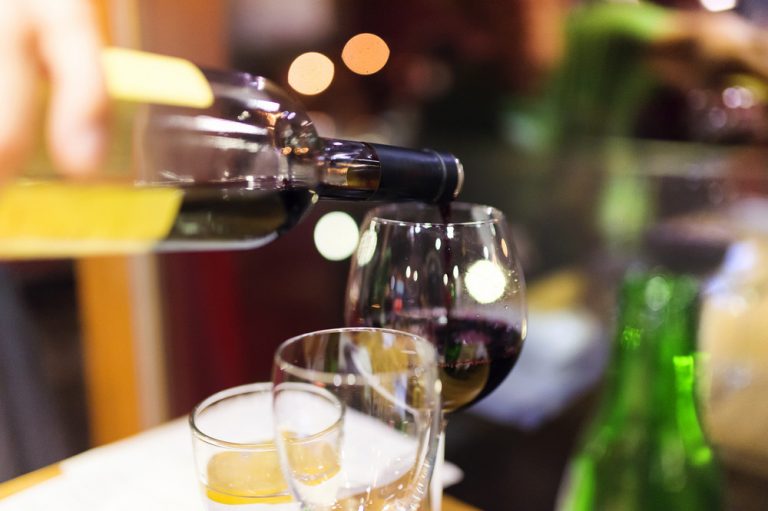





At one minute past midnight on the third Thursday in November, thie wine is released for sale. Talk about market share, in the next 24 hours over one million cases will be sold. During the coming year, consumers all over the world are expected to buy several dozen million bottles. On the other hand, many people are no longer so enchanted by this wine. For example, in Quebec, arguably the most wine-savvy province of Canada, sales of Beaujolais Nouveau have decreased by a whopping 90% since 1975.
Perhaps because of the rush to market the wine label contains virtually no information and my supplier provides no marketing materials. So I’ll present a few tidbits of information before my actual wine review. Beaujolais Nouveau wine comes from Beaujolais region of southeastern France and is made from the Gamay grape, which was kicked out of the world-famous, neighboring Burgundy region in 1395. By law, all the grapes in the Beaujolais region must be picked by hand. Champagne is the only other region of France that forbids mechanical harvesting. While Beaujolais Nouveau was first regulated in 1938, it dates back to ancient times when a somewhat similar wine was produced for slaves. History does not record their to this wine. Let’s take a look at mine.
I know that I’m over the $10 limit but this is an exceptional situation (we’ll see whether it is an exceptional wine). Furthermore, if your supplier stocks this wine it will probably slip under the $10 limit.
My first pairing of this wine involved smoked turkey thighs cooked with ground chicken meat balls, chick peas, and wheat kernels all in a tasty but hardly spicy turmeric and black pepper sauce. This wine was a bit raw. As expected, it had no tannins, surely one reason that many people go for such wine. The wine’s acidity wasn’t harsh but definitely wasn’t smooth. I tasted some bubble gum and some banana in the background. I can’t say that the situation is promising.
The next meal consisted of an omelet accompanied by packaged babaganoush (smoky eggplant salad) and humus (chickpeas) salad with jalapeno peppers. This time the wine was fruity, tasting mostly of black cherries. It had pleasant acidity. The jalapeno peppers were strong but the Beaujolais Nouveau dealt with them nicely.
Then I tried this wine with cold cuts, palms hearts, and a commercial potato salad containing chopped sour pickles. In the presence of roasted turkey breast slices (store bought) the wine was quite fruity but short. It did better when I added honey mustard, by some mistake the only mustard in the house. The wine was slightly spicy with the disappointing smoked veal breast. The meat was disappointing and the wine wasn’t so great either.
The first cheese was mild, yellow Cheddar. In this case the wine was round and fruity. Really it was quite pleasant. Then I went to a local but still overpriced Emmenthaler (Swiss-type) cheese. This cheese was more forceful, and consequently the wine was less forceful. While it didn’t step up to the plate, the combination was still good.
Final verdict. Can you guess? This is a party wine, one might say especially for those who really don’t like drinking wine. You can do better. You can also do worse. As long as both yours truly and the Beaujolais Nouveau phenomenon are around I’ll be tasting such wines. And someday, someday… But not now.
Levi Reiss has authored or co-authored ten books on computers and the Internet, but to be honest, he would
rather just drink fine Italian or other wine, accompanied by the right foods. He teaches classes in computers at an Ontario
French-language community college. His wine websites include
www.theworldwidewine.com
and http://www.wineinyourdiet.com
Visit his website devoted to Italian travel
www.travelitalytravel
Feel free to reprint this entire article which must include the resource box